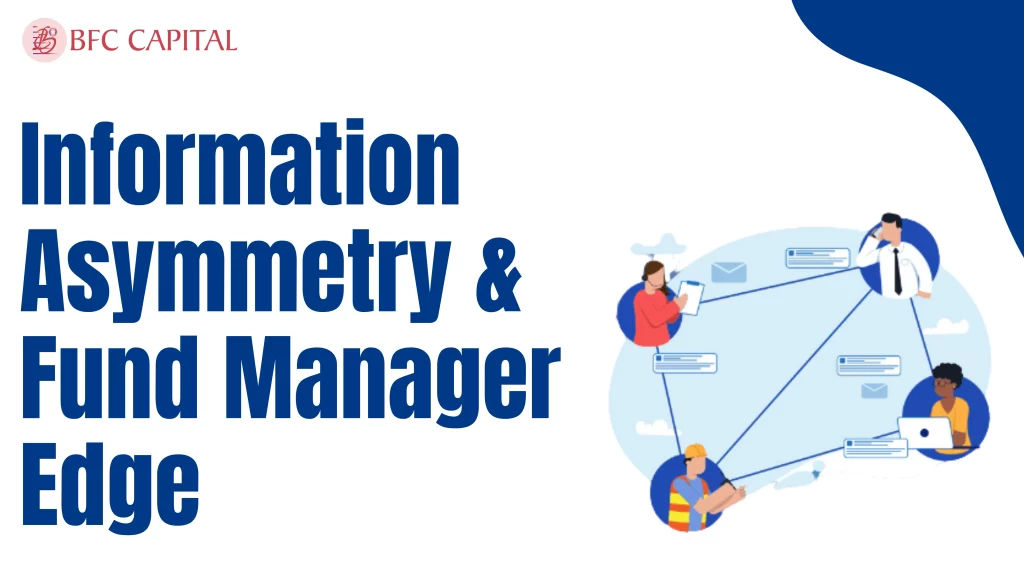
Information Asymmetry and Fund Manager
In finance, unequal information access, or information asymmetry, gives fund managers an edge. Like having a secret map, this extra knowledge helps them make better investments, trade time for trades effectively, and understand risks more deeply. They aim to generate alpha by harnessing privileged data in inefficient markets. By exploiting hidden signals, they gain a timing edge.
Navigating market inefficiencies through signal exploitation allows them to identify opportunities from informational delay, employing superior forecasting for potential profit. This highlights how information advantage is key to outperforming the market.
Bridging the Transparency Gap: How Information Asymmetry Fuels Fund Manager Advantage
Picture a game in which one player has a hidden map and the other does not.
That hidden map is similar to additional investment information that some fund managers possess but ordinary investors do not. This “information gap” (information asymmetry) provides these managers with an advantage.
Since they are better informed, they may:
Make better investments: Such as knowing where the buried treasure (good returns) is located.
Trade at the right moment: It’s the ability to buy low or sell high ahead of everyone else.
Better risk perception: It’s the ability to perceive potential hazards on the map that other people can’t.
This competitive edge enables them to make more money for their clients (and for themselves), but it also makes ordinary investors play on unequal terms.
Harnessing Privileged Data: The Key to Alpha Generation in an Inefficient Market
Imagine an unfair race where some runners are given a head start because they know the secret shortcuts.
In the stock market, “privileged data” is similar to those shortcuts – information that not everybody possesses. An “inefficient market” is similar to a poorly signposted racecourse where it is simpler to gain an advantage with additional knowledge.
“Alpha generation” is just getting a better return than the median. So this title is hinting that where information is not as widely distributed, fund managers who gain access to this insider information can take advantage of it to make smarter investment choices and earn greater returns (alpha) than others. They’re profiting from their inside information.
Exploiting Hidden Signals: The Timing Edge of Informed Trading in Portfolio Management
Think of a treasure hunt where some individuals have subtle hints (secret signals) regarding when and where the treasure will materialise.
“Informed trading” in this context refers to making investment choices based on this insider information. “Portfolio management” is similar to choosing how to allocate your money among various aspects of the treasure hunt.
This section is on how fund managers who can decipher these hidden clues – maybe recognising patterns others do not see or receiving early rumours of significant news – can develop a “timing edge.” This enables them to buy or sell at precisely the right times to enhance the overall performance (returns) of the funds they manage. They’re using their insights to anticipate the market’s moves.
Navigating Market Inefficiencies: Fund Managers and the Art of Signal Exploitation
The stock market is not always completely predictable; it has “market inefficiencies,” such as bumpy roads or secret shortcuts in a race. Experienced fund managers behave like clever drivers or runners who attempt to recognise subtle “signals” that others fail to notice. These signals might be early signs of a company’s future success or a change in market mood.
“Signal exploitation” is the ability to leverage these subtle indications to find an edge. A slight shift in the wind that suggests a forthcoming turn in the race, permitting you to rebalance your pace and overtake, is like it. Financial managers also examine multiple points of data and behaviours of markets to pick up on such camouflaged signals.
By seeing and responding to these subtle signals ahead of the broader market’s awareness of them, fund managers hope to “navigate market inefficiencies.” They’re attempting to identify the less clear but more lucrative routes in the investment world. This skill at reading and taking advantage of these concealed signals is a central part of their approach to hopefully providing better returns for their investors. It’s about being more attuned and taking action on things that may not be obvious to others.
From Informational Delay to Arbitrage Opportunity: Unlocking the Secrets of Superior Forecasting
The stock market isn’t always in exactly the right place; it contains “market inefficiencies,” such as bumpy roads or hidden shortcuts during a race. Successful fund managers behave like skilled drivers or runners who attempt to read subtle “signals” missed by others. Those signals may be early signals of a firm’s future prosperity or a change in market psychology.
“Signal exploitation” is the craft of leveraging these subtle hints to your advantage. Picture seeing a subtle shift in the wind that suggests an upcoming turn in the race, enabling you to shift your speed and pull ahead. Fund managers also look at numerous data points and market trends and try to catch these subtle signals.
By identifying and acting on these subtle signals before the broader market does, fund managers seek to “navigate market inefficiencies.” They’re basically trying to identify the less visible but more lucrative routes through the investment world. Their skill at reading and using these unseen signals is a central part of their strategy to possibly earn their investors higher returns. It is about being more discerning and acting based on insights that may not be evident to everyone.
On a parting note
The fact that information asymmetry exists in the financial markets provides opportunities for expert fund managers. By working hard to discover, interpret, and move on privileged information and refined market signals, they seek to capitalise on market imperfections and produce alpha for their investors. Their capacity to attain a timing advantage through knowledgeable trading and better forecasting is essential when managing the intricacies of portfolios and potentially realising arbitrage opportunities.
While such information superiority may be a generator of outperformance, it also exposes the underlying imbalances that are possible between well-funded professional investors and retail investors.
Please share your thoughts on this post by leaving a reply in the comments section. Contact us via phone, WhatsApp, or email to learn more about mutual funds, or visit our website. Alternatively, you can download the Prodigy Pro app to start investing today!
Disclaimer: This article is for educational purposes only and does not intend to substitute expert guidance. Mutual fund investments are subject to market risks. Please read the scheme-related document carefully before investing.