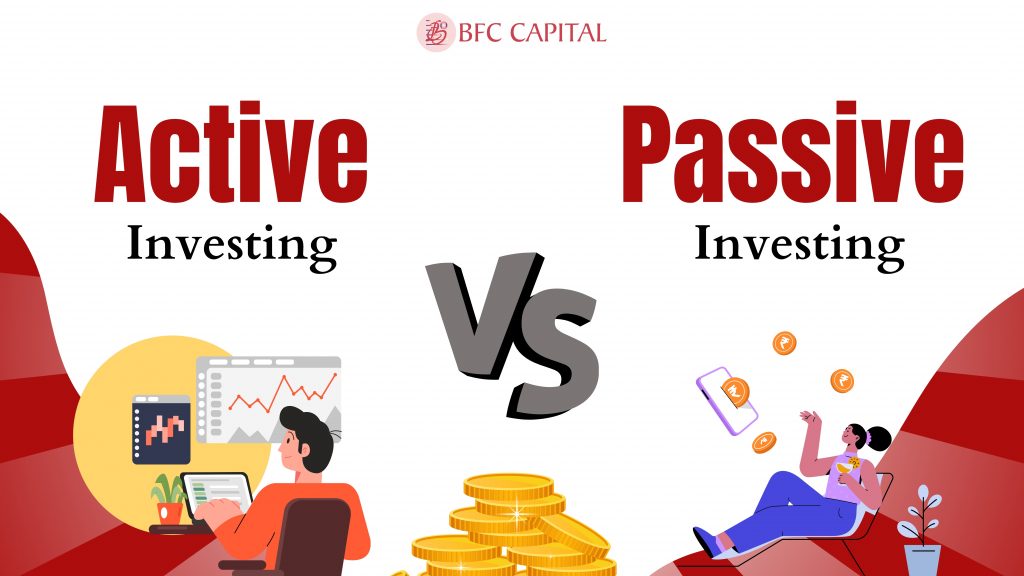
Active vs Passive Investing
Think of investing like piloting an aircraft. An astute navigator who constantly scans the horizon, making snap judgments to steer clear of turbulence and onto the best routes, is an active investor. In contrast, a passive investor follows a predetermined flight path that is influenced by market trends and technology, much like a car that drives itself.
Each approach has benefits, and the best option depends on your comfort level, risk tolerance, and investment goals.
Mutual fund portfolios can be actively or passively managed. Portfolio management refers to the process by which the fund manager buys and sells the underlying assets (equity, debt, gold, etc.).
An actively managed fund means that the manager is more involved in decision-making and actively determines which stocks and bonds enter and exit a mutual fund portfolio and when.
While this is the primary distinction between Active vs Passive Investing strategies, let us look at other differences to gain a better understanding of both!
Actively Managed Investments: A Direct Method
Professional fund managers choose which stocks to include or remove strategically while managing actively managed funds. By leveraging market trends and individual stock performance, these funds seek to beat the market as opposed to passively managed funds that only monitor an index.
An equities fund manager, for example, chooses companies carefully, taking into account many aspects such as business earnings, industry forecasts, and economic conditions. They keep an eye on the fund’s performance and modify the portfolio as necessary. This practical approach necessitates knowledge, investigation, and a sharp sense of market trends.
Fund managers actively choose securities in the debt, hybrid, and fund of funds categories by evaluating market conditions and investing goals. These methods are similar to each other.
What is a Passively Managed Portfolio?
We will also cover passive investing with an example. ETFs are passively managed investment products. ETFs are designed solely to track the movement of an index. Because SEBI (Securities and Exchange Board of India) determines what goes in and out of the index, the fund merely mimics its movement. The index results are turned into the returns that ETFs produce. Differences may be due to expense ratio charges, management fees, or other costs or dividends.
It, like the HDFC Sensex ETF, holds all shares in the same proportions as the Sensex. The fund manager will make small index modifications to bring the fund in line with the Sensex. If the Sensex is restructured, the fund management must make the same adjustments to their fund. In the case of passive portfolio management, the fund manager is supposed to monitor the benchmark’s performance.
Pros and Cons: Active vs Passive Investing
The differences between passive and active portfolio management strategies are unique in their ways. Let’s examine the pros and cons of actively and passively managed funds.
Pros of Actively Managed Funds
Alpha-generating funds: If an investor seeks more than what the benchmarks provide, actively managed funds are preferable. The primary and foremost goal of actively managed funds is to outperform the Sensex and Nifty! The fund management employs their experience, skills, and time to conduct market research.
Cons
Expensive: Naturally, as with a fund manager’s competence, everything wonderful in life comes at a price. Investors will be charged (via expense ratios) for the fund manager’s competence and decision-making.
Risk: Actively managed funds strive to create larger returns; hence, their risk is higher than that of passive funds. This is because human decision-making processes are susceptible to inaccuracy.
Pros of Passively Managed Funds
Cheaper: Their expense ratios are significantly lower than that of active funds. According to Sebi regulations, ETFs’ expense ratios cannot exceed 1%. As of May 11, the expenditure ratio for our previous example, the HDFC Sensex Fund, was only 0.05%.
Larger Market Exposure: Indices such as the Total Market Index, which consists of almost 750 equities, provide a larger view of the Indian stock market. So, if you invest in a fund that tracks the Nifty Total Market Index, you can have access to a diverse set of stocks with a single investment.
Cons
Cannot outperform benchmarks: These funds produce moderate returns that may be equal to or lower than the benchmark’s. They may be less expensive, but they incur certain fees, which reduces the returns slightly more.
On a parting note!
It is difficult to determine which of these categories is ‘good’ or ‘bad’; the distinction between Active vs Passive Investing strategies are more about their qualities than a good or terrible category. It all relies on the investor’s profile. The fact that an ETF directly maps to an index distinguishes a passively managed fund. If an investor seeks active management, can afford an active fund, and has appropriate risks and goals, active funds may be considered. However, if an investor does not want the fund manager to make too many decisions, wants the fund to match the benchmark simply, and does not want to risk anything, passively managed funds may be worth considering.
Please share your thoughts on this post by leaving a reply in the comments section. Contact us via Phone, WhatsApp, or Email to learn more about mutual funds, or visit our website. Alternatively, you can download the Prodigy Pro app to start investing today!
Disclaimer – This article is for educational purposes only and by no means intends to substitute expert guidance. Mutual fund investments are subject to market risks. Please read all scheme-related documents carefully before investing.