
Investors must analyze various funds’ performance to make a successful investment. This is achieved by using various frameworks. There are numerous investment instruments out there in the financial market. The two most widely used tools to evaluate the performance of any investment instruments are alpha and beta. These two tools estimate a fund’s performance, relation, and response following the changeability of the market.
What is Alpha?
Alpha is a framework to analyze the performance of the asset manager for his/her attempts in pulling the fund to return profits as set side by side with a benchmark index. A benchmark index is a pit against which the performance of the fund is evaluated in terms of alpha.
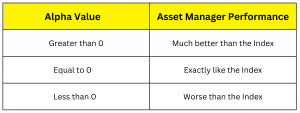
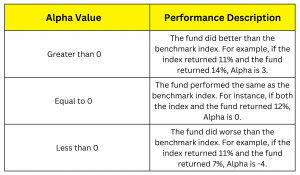
The alpha of a mutual fund has a threshold of 0. The values of alpha larger than, equal to, or less than 0 represent the fund’s performance against the benchmark index. Let’s understand this by taking an example:
- If the value of alpha is larger than 0, it signifies that the fund is doing better than the benchmark index.
- If the value is less than 0, it signifies that the fund is not performing well when compared to the benchmark index.
- If the value is equal to 0, it signifies that the fund and benchmark index is performing similarly.
What is Beta?
Beta is useful in measuring a fund’s response to the changeability in the market. Beta in mutual funds evaluates how the fund is displaying variations with the fluctuations in a benchmark index. It represents the vulnerability of a mutual fund to the volatility taking place in the index. The value of beta determines how balanced the fund is performing during a fluctuating market period.
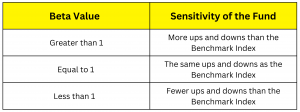
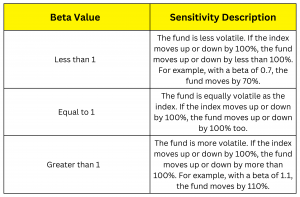
The beta of a mutual fund has a threshold of 1. Values larger than, equal to, or lower than 0 display the vulnerability of the funds concerning a benchmark index. Let’s understand this by taking an example:
- A beta value larger than 1 signifies that the mutual fund is more vulnerable to fluctuation in the benchmark index, which means the fund is displaying more changeability than the index.
- A fund with a beta value equal to 1 has a similar variation as that of a benchmark index.
- A beta value less than 1 displays that the fund is less flexible and is displaying lower deviations in consideration of the changes in a benchmark index.
Significance of Alpha and Beta
- It is essential to analyze a mutual fund’s previous performance before coming to any decision on investment. Although previous performance does not certainly imply the same way for future performance, it is still the best method to make smart investment choices. Alpha and Beta can help investors analyze a fund’s performance, and changeability compared to a benchmark index.
- Investors can make the use of beta ratio to make investments as per their risk tolerance. Investors who are not willing to take risks can stay away from the fund with funds that have a beta value much higher than 1 or the other way around.
- Investors can make use of the alpha ratio of a fund to analyze the fund manager’s performance. A value larger than 0 displays that the fund manager has done alright in managing the fund to drive higher returns.
- A stable value of alpha and beta is preferred by investors who do not want to take huge amounts of risks and want more than regular returns.
Calculation of Alpha and Beta
Alpha in mutual funds is evaluated using the following formula:
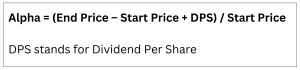
There is one more easy method to evaluate the alpha of a mutual fund by making use of CAPM (Capital Asset Pricing Model). Since CAPM displays returns that can be anticipated from a mutual fund, any variation from its value will be similar to that of alpha.
For instance, if a fund’s CAPM is 9% and the actual returns stand at 13%, the variation displays that the asset manager of the fund makes ends meet to drive 4% higher returns than what was anticipated. This signifies the value of alpha is 4.
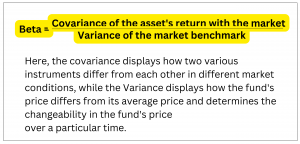
Beta in mutual funds is evaluated by making use of the following formula:
How Risks are Measured in Mutual Funds?
Alpha and beta provide investors with a method to evaluate risks and fluctuations connected with investing in a specific mutual. This helps them to set side by side various mutual funds and opt for the ones that suit their risk tolerance and investment objectives.
For Alpha:
For Beta:
Alpha and Beta are two important ratios to evaluate a mutual fund’s performance set side by side with a benchmark index. When it is used with indicators and ratios, you can make successful investment decisions and drive higher returns from your investments.
Final Words
Whenever you plan to invest in mutual fund schemes, make sure to check the Alpha and Beta values. It’s important to take into account that while considering these figures, you should also think about other factors such as the fund house’s reputation, existing market scenario, and portfolio distribution. This will give you a thorough knowledge of the fund you wish to invest in.
Please share your thoughts on this post by leaving a reply in the comments section. Contact us via Phone, WhatsApp, or Email to learn more about mutual funds, or visit our website. Alternatively, you can download the Prodigy Pro app to start investing today!
Disclaimer – This article is for educational purposes only and does not intend to substitute expert guidance. Mutual fund investments are subject to market risks. Please read the scheme-related document carefully before investing.








Name: Difference Between ROCE and ROE - BFC Capital- Blogs : All Financial Solutions for Growing Your Wealth
says:[…] Also, check out our recent post on: “What is Alpha and Beta in Mutual Funds| How it is Calculated?“ […]