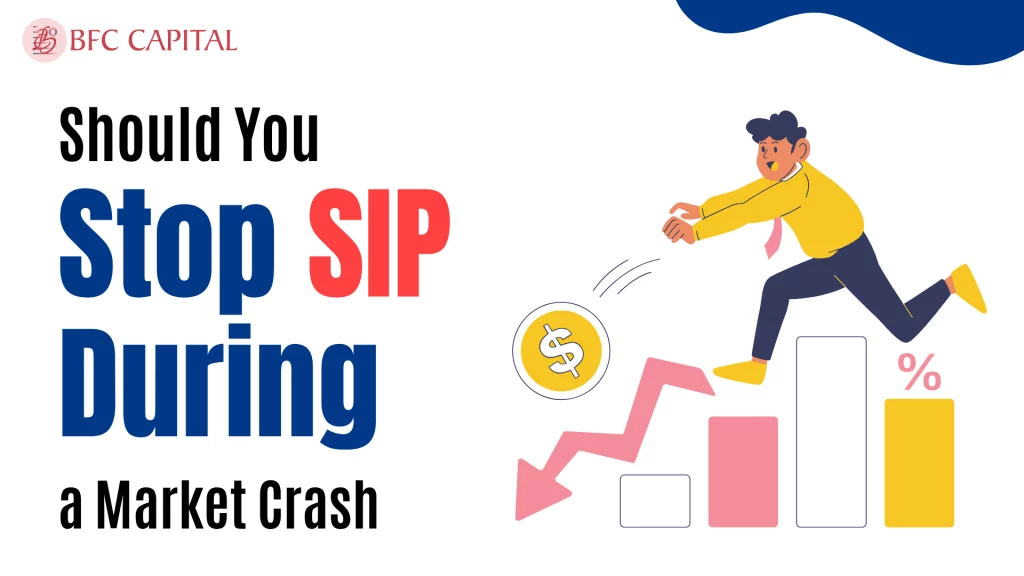
Stop SIP During a Market Crash
The stock market has just taken a nosedive. Headlines are screaming panic. Your investment app is filled with red numbers. And the first thought that crosses your mind is:
“Should I stop my SIP?”
If this question has ever haunted you, this post is going to answer it once and for all.
Why People Panic During a Market Crash
Let’s face it — no one enjoys seeing their investments go down. It triggers anxiety, fear, and the natural urge to “do something.” And in that moment, stopping your SIP might seem like a smart decision. After all, why throw good money after bad, right?
But here’s what most people don’t realize: SIPs are designed to perform best when the market is volatile.
Let me prove it to you.
Real Data. Real Story. Real Lessons.
Let’s say you started a monthly SIP of ₹10,000 in a growth and regular Fund on January 1, 2000.
Fast forward to January 2, 2002:
- Total Investment: ₹2.5 lakh
- Market Value: ₹2.08 lakh
Downward. Red. Losses.
Most investors would panic and withdraw.
But what if you didn’t?
By December 2005:
- Total Investment: ₹7.2 lakh
- Market Value: ₹35.6 lakh
Same SIP. Same fund. Just 3 years later. Patience made all the difference.
And it gets better.
By Jan 2008, your total investment would be ₹9.7 lakh.
- Market Value: ₹1 crore.
But then came the 2008 crash. Global financial crisis.
- Value dropped to: ₹42 lakh.
More panic.
But let’s say you stayed. You remembered your SIP is long-term.
By May 2010:
- Your portfolio is back to ₹1 crore.
Boom. Recovery.
Now, fast forward to February 2020, right before COVID:
- Corpus: ₹2.43 crore
April 2020 (post-COVID crash): ₹1.94 crore
Still stayed?
By December 2020: ₹3.17 crore
As of November 2024:
- Total Invested: ₹29.9 lakh
- Corpus: ₹9.7 crore
You read that right. All because you didn’t stop.
The Golden Rule: SIPs Are Not to Be Timed
Markets fall. That’s a given.
But timing the market perfectly? That’s a myth. Nobody can do it consistently.
SIPs work because they average out your cost over time. When markets crash, you buy more units. When they rise, your existing units grow. It’s a win-win.
Stopping SIPs during a dip is like stopping your umbrella halfway through a rainstorm.
When Should You Withdraw?
Only when you need the money. That’s it. Not because the market moved. Not because your friend said so. And definitely not because of panic.
Ideal Holding Periods By Fund Category
- Large Cap Funds: Hold at least 7 years. Avg. return: ~12%
- Mid Cap Funds: 8+ years. Avg. return: ~14%
- Small Cap Funds: 10+ years. Avg. return: ~16%
- Flexi Cap Funds: 7+ years. Avg. return: ~14%
- Thematic Funds: 9+ years. Avg. return: ~15%
These are minimum horizons — not exit timelines. Stay invested longer for better results.
Also, check – How SIP Can Turn ₹5,000 Per Month Into ₹13.76 Lakhs in 10 Years
Final Thoughts
The best time to start a SIP was yesterday. The next best time? Right now.
A market crash is not a reason to stop investing. It’s an opportunity to buy at a discount.
So, if you’ve made up your mind to start your SIP journey — or continue it with confidence — and you’re wondering where to invest, we can help.
Drop your details in the comments or connect with us at BFC Capital. We’ll help you find SIP schemes best suited to your goals and risk appetite. Until next time, keep investing. Keep growing.
Please share your thoughts on this post by leaving a reply in the comments section. Contact us via phone, WhatsApp, or email to learn more about mutual funds, or visit our website. Alternatively, you can download the Prodigy Pro app to start investing today!
Disclaimer: This article is for educational purposes only and does not intend to substitute expert guidance. Mutual fund investments are subject to market risks. Please read the scheme-related document carefully before investing.