Are you a risk taker and want to make money while investing? You are at the right place by investing in sectoral funds and thematic funds. You must look out for the risks associated with it. Mitigate your risks most effectively.
One of the key investing choices that let investors focus on specific sectors is sectoral and theme funds. Although these funds offer large returns, there is a high risk involved. We have provided you with detailed information on both the funds.
What are Sectoral Funds?
Sectoral funds are investment funds that focus on a particular sector where all funds invested are used to purchase stocks of the firms operating within the specific sector.
Example: Imagine there’s a buffet that focuses on a specific type of cuisine. Then consider going to a buffet where you have the option to choose from a variety of foods. Therefore, all the food should be from a single cuisine, like Italian, Indian, or Mexican. Similarly, the sectoral funds invest mainly in the companies of the given sector, for instance, technology, health, etc. If the given sector delivers good performance, then the fund too can provide good experience. But if the sector falls down, the fund’s performance might face problems since it’s not diversified across different industries.
Benefits of Sectoral Funds
- High Returns Potential: Due to the focus on the given type of stocks, sectoral funds can provide rather high revenues.
- Expert Management: The sectoral funds are under the direction of skilled persons who have sufficient understanding of the sector hence eradicating guesswork when investing.
- Diversification within the Sector: The investments are limited to a particular sector, however, the fund comprises many companies from the particular sector which to some extent can be diversified.
Risks of Sectoral Funds
- High Volatility: A significant risk associated with sectoral funds is that they tend to be very volatile because their performance is tied to only a particular sector. They include the economic, regulatory or technological changes that may likely hit the sector and influence the fund.
- Lack of Diversification: As sectoral funds only invest in one sector, the funds have no protection for the decline in sectors specific to the fund in contrast to diversified funds.
What are Thematic Funds?
Thematic funds are equity mutual Funds that invest in a focus area that is expected to progress in future periods.
Example: Imagine you having a song playlist which includes all your mood songs like workout song, chill mood song, romantic song, etc. These songs as we know are from different genres but they align with a similar theme. Similarly, thematic funds buy in areas, businesses, and shares of organizations within markets they presume will deliver a boost to that theme or concept under consideration. It’s a good product for those with higher risk tolerance levels, especially for those with long-term investment goals.
Benefits of Thematic Funds
- Broader Exposure: Compared to sector-specific funds, thematic funds provide more diversified exposure to companies across markets that are related to the theme, thus mitigating risk.
- Capitalizing on Trends: For the same reason, investors can make use of potential developments, which is a shift from existing ideas and inventions that are likely to be the causes of faster economic growth in the future.
- Flexibility: They are not limited to one business segment, which makes it easier for the managers of thematic funds to re-work the theme over time or as various segments provide better opportunities.
Risks of Thematic Funds
- Theme-Specific Risks: The level of diversification for thematic funds is across the sectors but the risks that pertain to the theme of the fund are still present. However, if the theme does not develop as expected, the performance of the fund is poor.
- Complexity: Sometimes, it may be difficult to unravel the various themes complicating the picture and that is why investors should be aware of what is happening in the world.
Who Should Invest?
Investors need to ensure that the fund’s advertised goal has a similar investment lifespan and risk tolerance level as what investors have in mind. So, investing in sectoral or thematic funds has certain prerequisites:
- Sector funds invest in established sectors like infra, power, banking etc. While thematic funds seek to capitalize on the growth prospects that exist in various sectors that benefit an emerging theme. Hence, it is a bet to directly buy undervalued stocks in both cases.
- When a theme/sector is set, these funds can provide a high yield which a normal mutual fund might not afford. They are in a position to optimise some disruption trends in the market
- Both of them are mutual fund variants as they start when the valuations on sectors or themes are high, and are considered high-risk investments. At the same time, these funds cannot be entirely compared to the previous performance, stats of such sectors/themes by then might have peaked
- These funds are not only for young and highly risk-tolerant investors with long-term time horizons but also for experienced ones. Market followers are knowledgeable and possess intimate knowledge about macro-economic factors that affect market trends
- Both funds can be utilised to manage the investment portfolio where they can help minimise loss. Diversification is the main tool to reduce risk. Investing in sectoral or thematic can offer diversification. Sometimes when some of the sectors/themes can provide above-average returns, investors can sneak into the right ones for growth. Since mutual funds are managed by professionals, fund managers employ various analytical techniques to optimize the returns
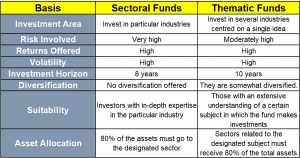
Difference Between Sectoral Funds & Thematic Funds
Bottom Line
Are you looking to get into sectoral or thematic funds, or are risks associated with it causing impediments? Don’t worry you are at the right place here you will get unique opportunities for investors looking to dive into specific sectors.
Therefore, both sectoral and thematic funds can be an important tool in a diversified investment portfolio. You must manage and organize it carefully.
Please share your thoughts on this post by leaving a reply in the comments section.
Also, check out our recent post on: “What is a Folio Number? Definition and Uses?“
To learn more about mutual funds, contact us via Phone, WhatsApp, Email, or visit our Website. Additionally, you can download the Prodigy Pro app to start investing today!
Disclaimer – This article is for educational purposes only and by no means intends to substitute expert guidance. Mutual fund investments are subject to market risks. Please read the scheme-related document carefully before investing.